

This Wednesday June 24 has brought dramatic moves across the markets that matter most to Iraq. Gold has crashed below $4,000 per ounce for the first time since November 2025, trading near $3,988 after a fall of more than 3%. At the same time, oil prices have dropped more than 4% as the Strait of Hormuz reopens following progress in the US-Iran peace process. For Iraq — a nation whose economy lives and breathes through oil exports and whose families hold gold as a store of wealth — both moves carry significant meaning.
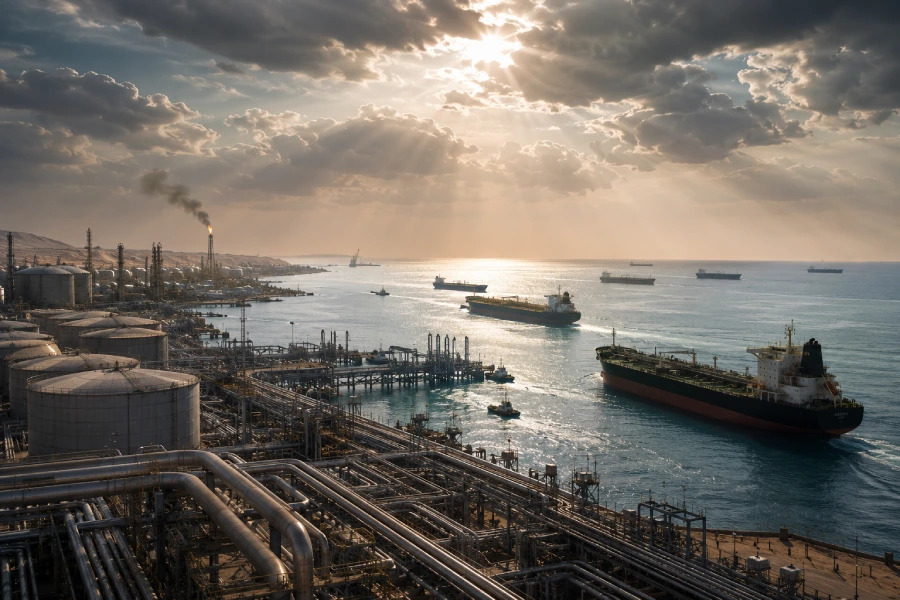
Begin with the development closest to Iraq’s interests: the Strait of Hormuz. Progress in US-Iran negotiations has encouraged a rise in traffic through the strait, and President Trump posted that Iran has informed the US it is not collecting transit fees there. For Iraq, OPEC’s second-largest producer with more than 90% of government revenue tied to oil exports through Gulf waterways, the reopening of Hormuz is fundamentally positive. It means Iraqi oil can flow more freely to Asian markets, shipping insurance costs ease, and the disruption that strained the economy for nearly four months begins to normalise.
But the same development carries a complication. As Hormuz reopens and supply fears fade, oil prices have fallen more than 4%. For an oil-exporting nation like Iraq, lower oil prices mean lower revenue per barrel, which pressures the national budget. This is the delicate balance Iraq now faces: the reopening of the strait restores export volumes and reduces costs, but the falling oil price reduces revenue per barrel. The net effect depends on how much volumes recover relative to how far prices fall — and a stable, normalised market is generally better for Iraq’s long-term planning than the volatile, disrupted high-price environment of the war.
For Iraqi gold buyers, today’s crash below $4,000 is the headline. Gold has fallen because the US Federal Reserve is now expected to raise interest rates aggressively — markets price a 68% chance of a September hike, up from 29% a week ago — which has driven the US dollar above 100 to its highest since May 2025. A stronger dollar mechanically lowers the dollar price of gold. Additionally, the easing of the war removed gold’s safe-haven premium, and a selloff in US tech stocks forced some investors to sell gold to cover losses. Three forces combined to break the $4,000 level.
What does this mean for Iraqi families holding gold? In the short term, the value of gold holdings has fallen. But the long-term picture remains supported. Gold is still up 20% over the past year, even after this steep correction. The structural demand that underpins gold remains firmly in place: central banks turned net buyers again in April, global gold demand hit a record 1,231 tonnes in the first quarter of 2026, and roughly 45% of central banks plan to increase their reserves over the coming year. History also offers perspective — every sustained break of the dollar above 100 since 2000 that came with high rate expectations ultimately reversed, creating extended periods of strong gold returns afterward.
For a nation that has held gold through wars, sanctions, and upheaval across generations, today’s drop below $4,000 is a difficult moment but not a reversal of the long-term case. For buyers, it represents the lowest prices in seven months. This week’s US PCE inflation data on Thursday will shape the near-term direction. The reopening of Hormuz is good news for Iraq’s economy; the gold correction, driven by cyclical monetary forces, is a moment that patient holders have weathered before.
Today’s prices: 24K — $128.00/gram | 22K — $117.33/gram | 21K — $112.00/gram
All prices USD. Indicative only. Please confirm in store.