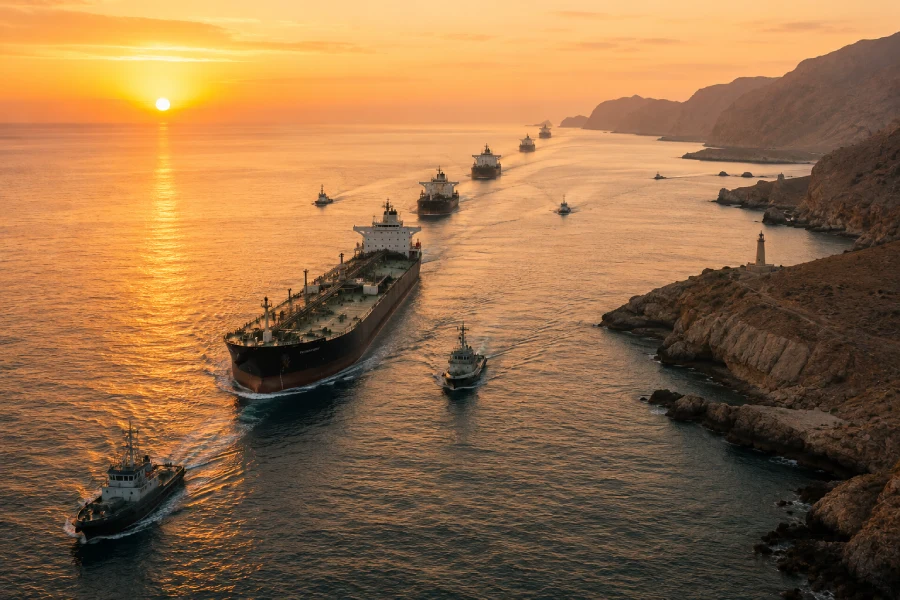


This Monday August 3 brings what may be the most genuinely hopeful development for Iraq since this war began. Ships have started moving through the Strait of Hormuz again — along a safe, temporary corridor near the Omani coast, arranged between Iran and Oman — while the United States has paused its planned airstrikes and talks may begin as soon as this afternoon. Gold is steady near $4,070 per ounce. For Iraq, whose economic lifeblood flows through that narrow waterway, the reopening of even a single shipping lane is news of the first importance.
Begin with why this matters so profoundly for Iraq. As OPEC’s second-largest producer, with more than 90% of government revenue tied to oil exports through Gulf waterways, Iraq has endured months of disrupted shipping, elevated war-risk insurance, and the constant threat of a fully closed Hormuz. Before the war, roughly 100 commercial vessels transited the strait daily; during the worst stretches, fewer than 10. Every tanker that could not sail represented revenue Iraq could not collect. The new corridor near the Omani coast — with vessels actually beginning to move through it — is the first concrete step toward restoring the export artery on which Iraq’s budget, salaries, and reconstruction all depend.
The diplomatic picture around the corridor remains tangled, and honesty requires laying it out. President Trump paused extended strikes planned for Sunday night — strikes he said would have been the “biggest attacks since World War II” — after regional allies urged de-escalation, and he announced that negotiations begin Monday afternoon with “a deal” on Hormuz close. Iran tells a different story: it rejects Trump’s claim that Tehran sought the pause, calling it a “new lie,” and insists it is negotiating only with Oman, not Washington. The two sides cannot yet agree even on whether they are talking. This gap is why caution remains essential — pauses have collapsed before in this war, and re-escalation on a single incident remains possible.
Yet for Iraq, the practical developments outweigh the rhetoric. Strikes are paused. Oil is moving. Prices at the pump of the global economy are easing — oil fell today on the news. If the corridor holds and widens, the benefits compound for Iraq: restored export volumes, lower shipping insurance, a stabilising region, and — through the chain this market knows well — cooling global inflation that would eventually ease the pressure on interest rates worldwide.
For Iraqi gold buyers, the moment carries a familiar balance. Gold is steady because de-escalation cuts both ways — easing the oil-driven inflation that suppressed it, while trimming safe-haven demand. But the long-term logic holds firm: a durable peace would free the US Federal Reserve to relax, and analysts see gold recovering toward $4,500 to $4,900 in that world. Gold near $4,070 is about 27% below January’s record, up roughly 20% over the past year, and fresh from its first winning month in five. The structural foundation remains exceptional: central banks bought a net 41 tonnes in May and 244 tonnes in the first quarter, with 89% of reserve managers expecting official holdings to rise.
For a nation that has weathered wars, sanctions, and upheaval across generations, today offers something rare: tangible movement toward normalcy. Ships in the corridor, strikes on pause, talks — perhaps — beginning. The road remains uncertain, and this week’s US jobs report on Friday will add its own turn to the story. But for the first time in months, Iraq’s most important waterway is carrying oil again, and that is a foundation on which hope can reasonably build.
Today’s prices: 24K — $130.75/gram | 22K — $119.85/gram | 21K — $114.40/gram
All prices USD. Indicative only. Volatile market. Please confirm in store.