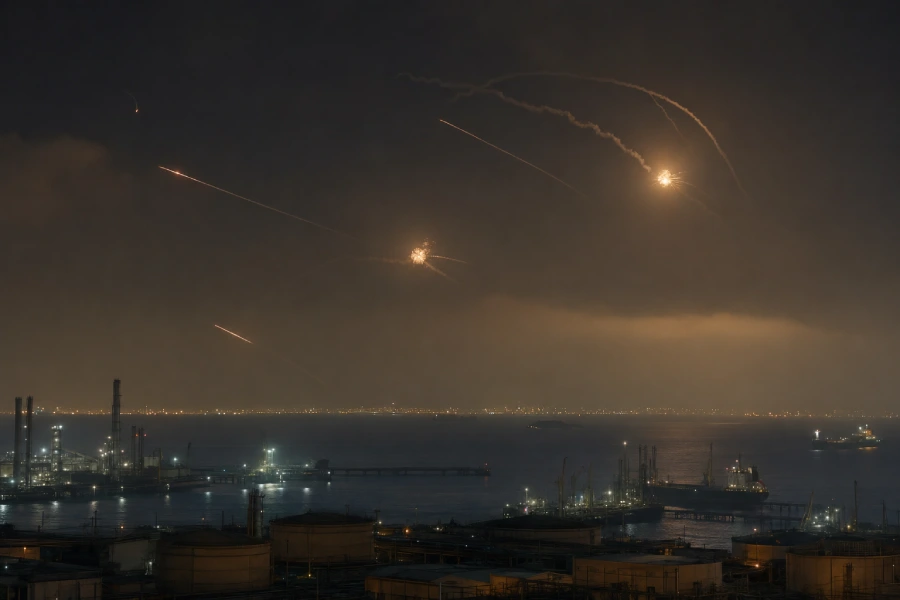


This Wednesday July 29 is a tense and consequential day for Iraq and the region. Overnight, the days-long pause in the US-Iran war collapsed as Iran’s Revolutionary Guard fired multiple ballistic missiles at US forces stationed in the Middle East — an attempted surprise attack that US forces intercepted. Oil prices jumped more than 4% in response. And this afternoon, the US Federal Reserve announces a pivotal interest rate decision. For Iraq, positioned at the heart of both the conflict and the regional oil economy, the stakes on this single day are considerable.
Begin with the reignited war, which lands close to home. Iran’s missile strike on US forces in the region — the exact locations of which carry direct implications for Iraq and its neighbours — ended the fragile pause that had briefly raised hopes of de-escalation last week. US Central Command confirmed all incoming missiles were shot down, but the message was clear: the diplomatic off-ramp that markets had hoped for has, at least for now, closed. This is deeply consequential for Iraq, whose economy depends on regional stability and the free flow of oil through Gulf waterways.
The oil price response underscores Iraq’s exposure. West Texas Intermediate crude jumped 4.7% to around $82.93 a barrel, and Brent rose more than 3% to $85.75, as the renewed attack revived fears about supply through the Strait of Hormuz. For Iraq, OPEC’s second-largest producer with more than 90% of government revenue tied to oil exports, this volatility is a double-edged reality: higher prices per barrel offer some revenue benefit, but the underlying instability and the continued restriction of Hormuz shipping threaten the reliable exports on which the nation depends. Just days ago, a pause had sent oil tumbling and raised hopes; today’s re-escalation reversed that abruptly.
For Iraqi gold buyers, today’s steadiness in the gold price reflects a balance of forces. Gold is holding near $4,050 because the war pushes it two ways at once: the oil-driven inflation threat argues for higher US interest rates (which pressures gold), while the safe-haven demand from the conflict supports it. Layered on top is this afternoon’s Federal Reserve decision, where Chair Kevin Warsh’s tone will shape expectations for September. The result of these competing forces has been remarkable stability.
For Iraqi families who hold gold across generations, the enduring case remains firmly intact. Gold near $4,050 is about 28% below January’s record of $5,597, yet up roughly 19% over the past year, and it has held above $4,000 for two full weeks despite the turmoil. The structural foundation is exceptionally strong: central banks bought a net 41 tonnes in May and 244 tonnes in the first quarter, and 89% of reserve managers expect global central bank gold holdings to keep rising. This steady demand is why gold holds its value through exactly the kind of instability the region is experiencing.
For a nation that has weathered wars, sanctions, and upheaval across generations, this tense day is a reminder of gold’s enduring role as a store of wealth through uncertainty. The war’s path remains unpredictable — today’s re-escalation could deepen, or diplomacy could resume. The Fed decision this afternoon and tomorrow’s PCE inflation data are the key financial events. For Iraqi buyers, gold near $4,050 remains at attractive levels, anchored by relentless central bank demand, offering stability in an unstable time.
Today’s prices: 24K — $130.05/gram | 22K — $119.20/gram | 21K — $113.80/gram
All prices USD. Indicative only. Volatile market. Please confirm in store.